I’m always searching for the perfect chocolate cake recipe – one that uses oil instead of butter so that it’s moist, doesn’t have too much sugar, and isn’t too complicated to whip up at short notice. I found a recipe that was pretty close and made some of my own modifications. It’s super moist, and the recipe is straight-forward. It’s also perfect for splitting and filling with whipped cream and your favorite jam.
¾ cup (180ml) Greek yoghurt (full fat or non-fat is fine)
1 teaspoon (5ml) vanilla extract
1 cup (240ml) hot coffee
Instructions
Preheat the oven to 350°F. Lightly grease two 8-inch cake pans, option to dust lightly with flour or cocoa powder (the cocoa powder clings to the sides of the pan and can help the cake to rise higher). Line the base with circles of parchment papers. (It’s best not to use springform pans as the cake batter can leak out).
Make the coffee and keep it hot. I usually make an espresso (I use decaf since not everyone wants the caffeine) and add hot water to make up to a cup. If you are using instant coffee, add 1 tablespoon of instant coffee granules (or 2 teaspoons of espresso powder) to 1 cup of boiling water. Put aside and continue with making the cake batter.
Combine the dry ingredients. Sieve the flour, cocoa powder, baking powder and baking soda into a large bowl. Add both types of sugar and salt, and whisk to blend well. Ensure the ingredients are combined, working out any lumps of brown sugar.
Combine the wet ingredients in a separate bowl. Adding the eggs, oil, Greek yoghurt and vanilla, and whisking to blend.
Use a spatula to make a well in the center of the dry ingredients, then pour in the wet ingredients.
Mix with an electric handheld mixer on medium-low speed until blended. Option to use a stand mixer with whisk attachment. The mixture will be fairly dry.
Add the hot coffee gradually in two stages, mixing until evenly combined and the batter is smooth. The batter will be quite thin.
Divide the batter evenly between the prepared pans and tap the pans on the countertop to allow any large air bubbles to surface and pop.
Bake for 30-35 minutes until cakes spring back when pressed gently and a skewer inserted into the center comes out clean. Transfer pans to a wire rack and let cool for 15 minutes before running a knife around the sides and turning the cakes onto the rack to cool completely.
Optional: Half each cake horizontally and remove the top layer of one of the cakes (this gives you four layers – three flat and one with the top). Then you can build your layers, a layer of whipped cream, then jam, then whipped cream and then the remaining top of one of the cakes.
Did you know that pineapples come in two varieties? The common yellow pineapple and the white pineapple. Also known as the sugarloaf pineapple, or the Big Island sugarloaf, the white pineapple can be elusive, and is usually found only on the Big Island or on Kaua’i.
We have a large number of white pineapple plants growing here at Horizon Guest House, as part of our fenced vegetable garden (in order to protect from the odd wild pig).
The white pineapple generally has a much sweeter taste, and a much lower acid profile. The flesh of the pineapple is white, rather than yellow, and the core is edible (it’s generally softer and less fibrous).
When ripe the Big Island Sugarloaf pineapple will have a green exterior and will feel tougher than a yellow pineapple. A golden yellow color on a white pineapple likely indicates that it is overripe.
Pineapples are a bromeliad. They can reach 3 to 4 feet high. The fruit itself emerges from the plant at the end of the central stalk. The long leaves around the stalk are used to collect and absorb water, rather than through the roots.
See the below photo for the contrast between the white and yellow pineapple flesh.
This recipe is perfect for Thanksgiving when you need to make something with only the most basic of ingredients on hand (plus a can of pumpkin purée). This cornbread works as both a side for Thanksgiving or as a dessert. We’ve adapted the recipe from The New York Times by substituting plain yoghurt for buttermilk, making this something that’s easy to whip up on Thanksgiving morning.
• ½ cup plus 2 tablespoons/140 grams unsalted butter (1¼ stick), melted, plus more for greasing the pan • 1 cup/180 grams finely ground yellow cornmeal • 1 cup/130 grams all-purpose flour • 1 teaspoon baking powder • ¾ teaspoon kosher salt • ½ teaspoon baking soda • 1 large egg • ¾ cup/165 grams packed light or dark brown sugar • 1 cup/240 milliliters canned pumpkin purée • ½ cup/120 milliliters buttermilk or Plain Greek yoghurt • ½ cup plus 2 tablespoons/150 milliliters maple syrup • ¼ cup/15 grams pumpkin seeds (pepitas)
Instructions
Heat the oven to 375 degrees. Butter an 8-inch square baking pan (we used a glass dish of a similar size). Line with parchment paper, leaving a 2-inch overhang on two sides. Butter the parchment.
In a medium bowl, whisk together the cornmeal, flour, baking powder, salt and baking soda.
In a large bowl, whisk together ½ cup melted butter, the egg, brown sugar, pumpkin purée, buttermilk/yoghurt and ½ cup maple syrup.
Fold in the dry ingredients. Transfer the batter to the prepared pan, and smooth out the top.
Top evenly with the pumpkin seeds.
Bake until a toothpick inserted into the center comes out clean and the surface has turned a dark brown color – 25 to 30 minutes, but may need up to 45 minutes. Meanwhile, combine the remaining 2 tablespoons of melted butter and the remaining 2 tablespoons maple syrup.
Transfer bread in the pan to a wire rack. While the bread is still warm, brush the entire surface with the butter-maple mixture. Remove the cornbread from the pan using the overhanging parchment, and cut cornbread into pieces. Serve warm or at room temperature.
Heading south from the Kona Coast and need a quick itinerary? We have you covered. We outline the major attractions, where you should stop, and the best way to do it – especially if you’re pressed for time.
Turtle at South Point
South Point
Buzz’s: a local store selling coffee, chocolate, nuts and home to the Big Island’s friendliest pig, Penny. For more details https://www.hawaiislocalbuzz.com/
South Point cliff: not only the southern most point in the USA but also a chance to cliff jump for those brave enough!
Green Sand Beach: it’s a 5 mile return hike, but most people pay $20 per person to ride in the back of a pickup truck driven by friendly locals back and forth from the parking lot.
Punalu’u Bakery: stop here for their famous malasadas and sweet bread.
Hana Hou Cafe: across the street, make it a lunch stop at this local favorite with a great lunch menu and delicious pies.
Don’t forget the speed limit: it’s posted at 25 mph due to two nearby schools.
Photo credit: thishawaiilife.com
Scenic Lookout
Only a mile south of Na’alehu is the Haleokane scenic lookout with dramatic coastal views which are worth a stop for photos.
Turtle at Black Sand Beach
Punalu'u Black Sand Beach
Located just off the highway this is where you’re most likely to see turtles having a nap on the beach. Park at the souvenir shack. The road to the beach is a loop, so when done continue along and you’ll get back on the highway to Volcano.
Photo credit: bigislandguide.com
Ka'u Coffee
A relatively new coffee producer with a visitor’s center. Located about 5 miles from Black Sand Beach, turn left at the ‘Pahala’ sign. At the T intersection turn right and proceed about 3 miles.
Photo credit: nechung.org
Buddhist Temple
Located another 2 miles from Ka’u Coffee, take a left at the next T intersection and the temple is located about another 200 feet. For more information on the temple https://www.nechung.org
Volcano National Park
Head straight for the visitor’s center after entering the park. Across the street is the Volcano Lodge, with views of the crater. Next to the visitor’s center is an excellent art gallery with a wide range of items locally made.
Photo credit: Hawaiianislands.com
Volcano Village
Turn right when exiting the National Park and proceed about 1 mile, then turn left – this is the main street of Volcano Village. There is a gas station, a tiny grocery store and 3 decent restaurants, including Thai Thai.
Akasuka Orchids
Less than 5 miles towards Hilo, this is a great orchid garden with a very large growing facility.
1 cup roasted peanuts (optional to roast again in the oven prior for extra flavor)
¼ cup of dark chocolate (buttons or chips)
Makes 20 brownies (cookies)
Instructions
Oven roast the peanuts for about 10-15 mins at 350F (lay out on an oven tray). Cream butter and sugar until the mixture is light and fluffy. Add egg and mix well.
In a medium bowl, sift flour, baking powder, salt and cocoa powder together. Add to creamed mixture and mix well.
Add peanuts and chocolate (if using chocolate buttons chop roughly). Mix well.
Divide mixture and roll into about 20 balls. Place balls on a greased oven tray. Use a floured fork to flatten each brownie.
Bake for 15-20 minutes at 350F. Remove from oven and allow time to cool.
Honolulu mid-19th century. Photo: Courtesy of the Hawai‘i State Archives
Mark Twain would spend four months in the Hawaiian Islands – traveling to Oahu, Maui, and the Big Island – while writing letters about his travels for the Sacramento Union. Letters from his time on the Big Island provide an interesting view of the island as it was in the 1860s.
Mark Twain, age 31 (Abdullah frères, Public domain, via Wikimedia Commons)
When Mark Twain first sighted the shores of Hawaii Island he was impressed by the imposing size of Mauna Loa and Hualalai, in particular Mauna Loa, describing the ‘rays of glittering snow and ice, that clasped its summit like a claw’. On arrival in Kailua-Kona he was struck by the sleepy nature of what was then just ‘a little collection of native grass houses reposing under tall coconut trees’.
Mark Twain arrived on the Big Island in July 1866, having traveled from Honolulu where he had been based for some time. After arriving in Kona, he traveled on horseback south to Kealakekua Bay. The road south at this time was overgrown, with the route veering inland, out of sight of the ocean, and the path; shaded by ‘trees, whose great boughs overarch the road and shut out sun and sea and everything, and leave you in a dim, shady tunnel, haunted with invisible singing birds and fragrant with the odor of flowers’.
Kealakekua Bay and Captain Cook's Monument. Illustration taken from Roughing It by Mark Twain (1872)
Twain believed that Kona coffee had a ‘richer flavor than any other’ and noted that the coffee industry had been plagued by a recent ‘blight’ while exports of coffee remained insignificant compared to exports of sugar. In 1865, 263,000 pounds of coffee were exported from the islands compared with more than 15 million pounds of sugar. Oranges were also an important industry at the time with approximately half a million oranges exported in 1865, mostly to California. Twain considered that ‘there are no finer oranges grown in the world’ than those grown on the Kona Coast.
When he arrived in Kealakekua Bay he was greeted by a summer rain and ‘two magnificent rainbows’. It was here he visited the spot where Captain Cook was killed, and tried in vain to imagine Cook’s last moments but ‘could not do it’.
Traveling on by canoe to Honaunau, he was struck by the immensity of Mauna Loa, the ‘long mountain with its rich green forests stretching up into the curtaining clouds’. Dolphins surrounded the canoe, ‘arching over a wave and disappearing, and then doing it over again… like so many well-submerged wheels’.
While visiting Place of Refuge (Puʻuhonua o Hōnaunau) he walked part of the King’s trail, remarking with surprise at the ‘considerable degree of engineering skill’ of the paved pathway, and that it reminded him of the ancient roads ‘out of Rome’.
1866 Volcano House (National Park Service, HAVO Archives, Photo 4781, Courtesy of Bishop Museum)
Twain continued on by boat south to Kau and then via mule to Volcano where he stayed at Volcano House which had only just opened about three months prior. He was surprised at ‘finding a good hotel in such an outlandish spot’. He remained in awe while observing the simmering volcano at night:
‘It was ringed and streaked and striped with a thousand branching streams of liquid and gorgeously brilliant fire! It looked like a colossal railroad map of the State of Massachusetts done in chain lightning on a midnight sky. Imagine it––imagine a coal-black sky shivered into a tangled network of angry fire!’
Twain declared that his ‘jaunt through Kona will always be to me a happy memory’.
For further reading about Mark Twain’s time in Hawaii see Mark Twain’s Letters from Hawaii. Honolulu: University of Hawaii Press, 1975.
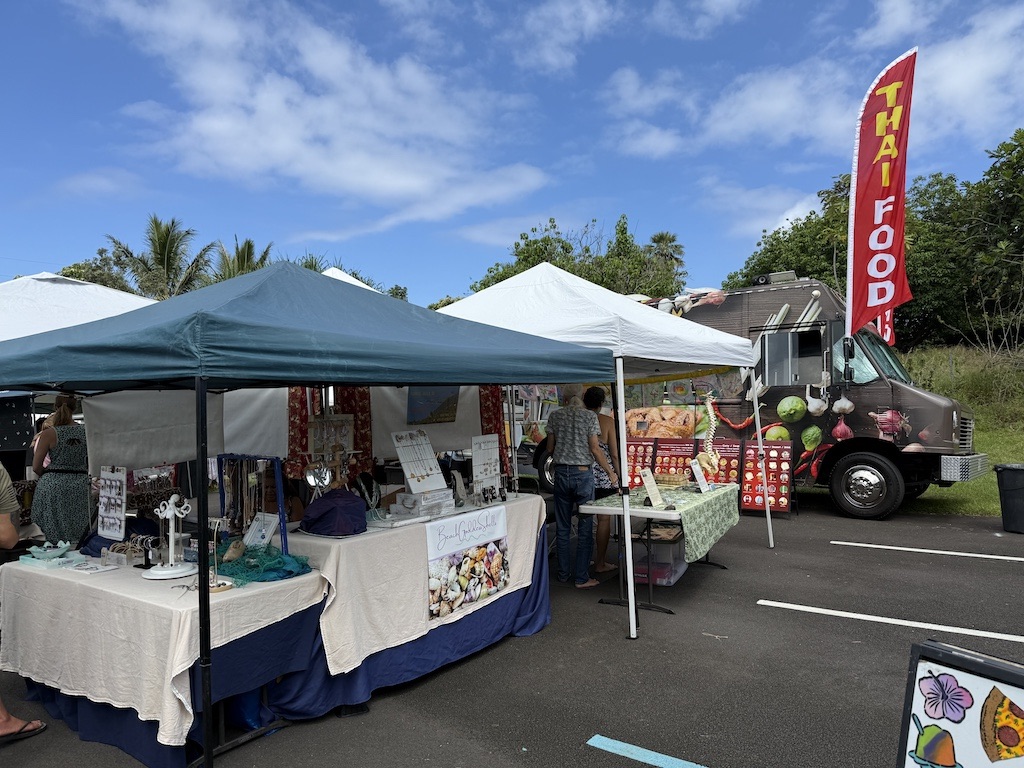
The Pure Kona Green Market operates every Sunday from 9am-2pm, and is dedicated to supporting local farmers, crafters and also promoting sustainable agriculture.
The market is held in the parking lot of the Amy B. Greenwell Ethnobotanical Garden in Captain Cook, approximately 12 miles south of Kona on highway 11. The market features live music, and the garden itself is also open during the market hours.
The market includes vendors selling a range of food including, honey, Korean food, fresh produce, sweet buns, pizza, fresh bread, Thai food, coffee, mac nuts, dried fruit, chocolate, shaved ice, fresh fish, and more.
Herbal products, essential oils, handmade soaps, and jewelry are also sold at the market.
Get there early to secure parking. There is more parking behind the market itself.
There are also plenty of local artists, working in a variety of mediums from wood to pottery, photography and more. There are plenty of opportunities to purchase locally made gifts.
How to get there
Located in Captain Cook directly opposite the Manago Hotel, in the parking lot of the Amy B. Greenwell Ethnobotanical Garden.
This is a great variation on banana bread, with chocolate chips for that extra something special. Allspice, cinnamon and molasses give the cake a unique, aromatic flavor.
Recipe from Jim Lahey and Maya Joseph, adapted by Melissa Clarke at New York Times Cooking.
Heat oven to 425 degrees. Grease an 8-inch round cake pan and line the bottom with parchment paper.
In a medium bowl, whisk together flour, baking powder and fine sea salt.
In the bowl of an electric mixer fitted with a paddle attachment, beat butter, oil, sugar, brown sugar, molasses, allspice, cinnamon, espresso and vanilla until just combined. The secret to this cake’s texture is to stop mixing before the sugar is dissolved.
Use a spatula to mix egg into butter mixture, then stir in flour mixture just to combine. Fold in bananas and chocolate chips. Scrape batter into prepared cake pan and bake until top is golden and sides begin to pull away from pan, about 25 minutes.
Let cool for at least 20 minutes (or longer, until completely cooled), then run a thin spatula around the edges to separate from the pan. Invert onto a serving plate. Cake will keep for 1 day, covered.
The Amy Greenwell Ethnobotanical Garden is located in Captain Cook (the parking lot hosts the Pure Kona Green Market on Sundays) and covers 15 acres, planted with endemic and indigenous Hawaiian plants and also plants brought by the first Polynesian arrivals to the islands.
The garden is also a designated community forest and contains over 200 species of native and Polynesian-origin plants.
Amy Greenwell was part of a ranching family who have lived in the area since the mid-nineteenth century. Amy was interested in botany and ethnobotany and donated the property to the care of the Bishop Museum in 1974.
Plants include kale (taro) and mai’a (banana). There is also an archaeological area, spread over 5 acres, which encompasses historic agricultural land.
Parts of the garden reflect different ecological zones: Coastal zone, dry forest, Polynesian-introduced area and wet forest, each zone changing with the elevation.
(above) ‘Ulu or breadfruit.
(above) hue wai (gourd water containers)
The Amy Greenwell garden is worth visiting if you have any interest in Hawaii’s native plants and the way in which native Hawaiians grew crops in the area.
Manini Beach Park is situated opposite the Captain Cook Monument in Kealakekua Bay. The beach itself is mostly rocky but there is a sandy strip between the rocks that provides an easy point of entry into the ocean. Snorkeling is easy and accessible.
Though small, the beach park has plenty of shade and a nice grassed area on which to relax and enjoy a picnic.
The red arrow shows the space between two rocky areas where a strip of sand provides easy access.
Kayakers in the bay. It is possible to launch a kayak out of Manini Beach Park.
Who manages Manini Beach Park?
Also known as Kapahukapu, Manini Beach is under the stewardship of The Healy Foundation. Kamehameha Schools owns the land and the foundation has leased the land, taking care of the park, providing maintenance, a community garden, and bathroom facilities. Find out more here.
Above is the entry point to the beach park, parking is to the left of this entryway.
Parking is limited and the beach park itself has a limit of 50 people in the park at any one time. The park is privately owned but open to the public. Take care to park in the allocated zones and not to block access to nearby homes. The park is open from 6am to 8pm daily.
How to get there
From North Kona
Traveling on Highway 11, turn onto Napo’opo’o Road (Hwy 160) just south of the 111-mile marker. In about 3 miles (5k), turn right to stay on Napo’opo’o Road, continuing 1.7 miles (2.7k) to Kealakekua Bay. Turn left onto Pu’uhonua Road (still Hwy 160). Just a few hundred yards south of the Kealakekua Bay boat launch, turn right onto Manini Road.
From South Kona
Traveling on Highway 11, turn on to Middle Keei Road and follow it down until it joins Napo’opo’o Road, turn left and stay on Napo’opo’o Road, continuing 1.7 miles (2.7k) to Kealakekua Bay. Turn left onto Pu’uhonua Road (still Hwy 160). Just a few hundred yards south of the Kealakekua Bay boat launch, turn right onto Manini Road.